
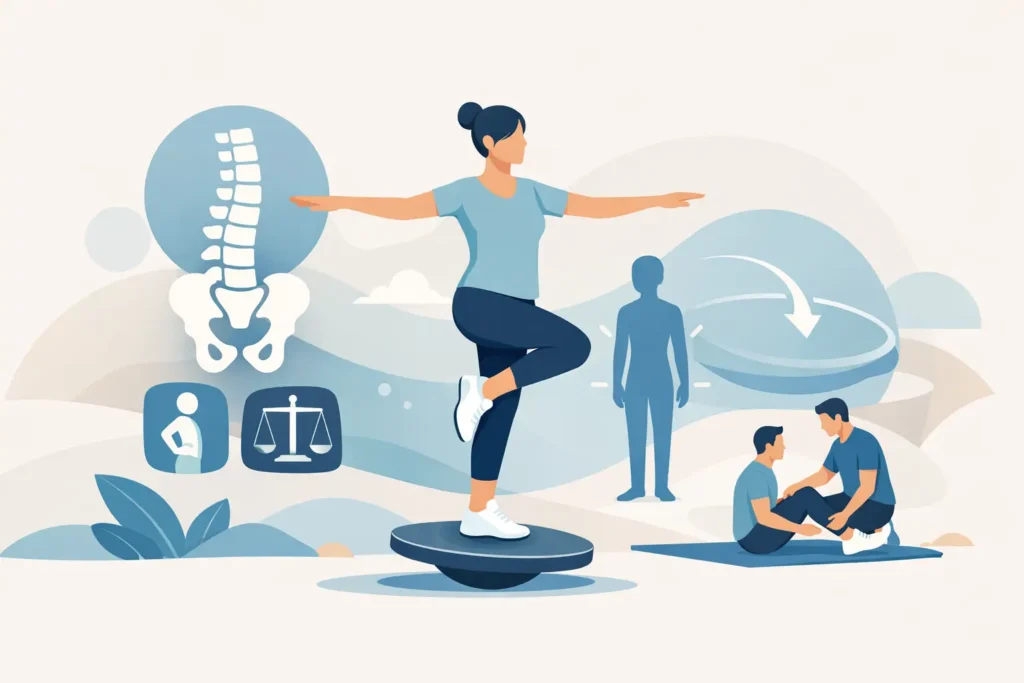
A missed step on the stairs, a wobble when turning quickly, or the need to grab the counter while putting on shoes can feel like small moments. Yet they often point to a larger issue: your body may not be receiving, processing, or responding to movement signals as efficiently as it should. Understanding how postural rehab improves balance can help you see why lasting stability involves more than simply trying to stand up straighter.
Balance is a whole-body skill. Your brain relies on information from your eyes, inner ear, joints, muscles, and feet to know where your body is in space. When posture, mobility, strength, or coordination are compromised, that information can become less clear. Postural rehabilitation works to address those underlying movement patterns so your body can move with more confidence and control.
Balance Is More Than Standing Still
Many people think of balance as the ability to hold a one-legged position. That is one measure, but daily balance is more dynamic. It is what helps you shift your weight while carrying groceries, turn to look behind you while walking, step off a curb, get up from the floor, or catch yourself after a stumble.
Good balance requires your body to make quick, coordinated adjustments. Your feet and ankles need to sense the surface beneath you. Your hips and core need to stabilize your center of mass. Your spine needs enough mobility to allow natural movement, while the nervous system needs to organize all of those signals quickly.
Pain, previous injuries, long hours at a desk, pregnancy-related changes, an auto accident, and repetitive work positions can all influence this system. You may begin favoring one side, holding tension through the neck and shoulders, or limiting movement because it feels uncomfortable. Over time, these compensations can change how you stand, walk, and react to everyday movement.
How Postural Rehab Improves Balance at Its Source
Postural rehabilitation is not a one-size-fits-all series of exercises. It begins with understanding how your body is currently functioning. A thorough assessment may look at posture, spinal and extremity motion, muscle activation, walking patterns, coordination, and areas of pain or restriction.
The goal is not to force the body into a rigid, picture-perfect posture. Healthy posture is adaptable. It allows you to sit, stand, bend, reach, and walk without placing unnecessary strain on the same tissues over and over. Rehabilitation helps identify where your body has lost that adaptability and creates a plan to restore it.
It improves body awareness
Your body has a built-in sense of position and movement called proprioception. This is what lets you touch your nose with your eyes closed or know where your foot is when stepping onto uneven ground. When a joint is stiff, painful, weak, or recovering from injury, proprioceptive signals may be less reliable.
Targeted rehabilitation exercises can help retrain this awareness. Slow, controlled movements teach you to notice where your pelvis, ribs, shoulders, knees, and feet are positioned. As your awareness improves, your body can make more accurate corrections before a loss of balance becomes a fall.
It builds stability where you need it
Balance does not come from gripping the floor with your toes or bracing every muscle. It comes from having the right muscles activate at the right time. The deep core, hips, glutes, legs, and muscles around the ankles all contribute to stability.
Postural rehab may include exercises that strengthen these areas while improving how they work together. For example, someone whose knees collapse inward when walking may need hip and foot control, not just stronger thigh muscles. Someone who feels unsteady after a neck injury may need a plan that includes cervical mobility, postural endurance, and gradual coordination work.
The right approach depends on the person. More challenging balance drills are not always better, especially when pain, dizziness, recent injury, or significant weakness is involved. Building a reliable foundation first is often the safer and more effective path.
It restores useful movement
Restricted motion in the spine, hips, ankles, or shoulders can cause the body to compensate elsewhere. If your ankle does not bend well, for instance, you may shift your weight differently when squatting, climbing stairs, or walking. If your upper back is stiff and your head sits forward, turning and scanning your environment can feel less fluid.
A personalized plan may combine hands-on care, spinal or extremity adjustments when appropriate, and corrective exercises to improve mobility and control. The purpose is not just to increase range of motion on an exam. It is to help you use that movement in daily life with less strain and more stability.
The Connection Between Posture, Pain, and Confidence
Pain can change balance even when the painful area is not in your feet or legs. Back pain may make you move more cautiously. Neck pain can affect how easily you turn your head. Sciatic symptoms can alter your gait, while headaches or dizziness may leave you feeling less secure with quick movements.
When movement hurts, the nervous system often responds by creating protective tension. In the short term, that response can be useful. If it continues, however, it may lead to guarded movement patterns that limit mobility and reduce confidence.
Postural rehabilitation aims to help break that cycle. As movement becomes more comfortable and controlled, many patients find it easier to return to the activities they have been avoiding, whether that means walking the River Walk, exercising, playing with children, or simply getting through a busy workday without feeling unstable.
What a Personalized Balance-Focused Plan May Include
At Align Chiropractic and Wellness, care is designed around the individual rather than a generic exercise sheet. Objective findings and regular re-evaluations help guide the plan and show whether your body is responding as expected.
Your recommendations may include a combination of chiropractic care to address joint function, postural rehabilitation exercises to improve strength and coordination, and simple home exercises to reinforce progress between visits. Lifestyle factors matter, too. Sleep habits, workstation setup, stress, activity level, footwear, nutrition, and recovery can all affect how your body feels and performs.
Home care should be realistic. A few consistent minutes of well-chosen movement can be more valuable than an ambitious routine that never fits into your week. Your provider can help you understand which exercises support your goals and which movements may need to be modified while you recover.
When Balance Changes Deserve Prompt Attention
Not every balance concern comes from posture alone. Sudden dizziness, fainting, new weakness, numbness, changes in speech or vision, severe headache, chest pain, or trouble walking should be evaluated promptly by the appropriate medical professional. These symptoms may require urgent medical attention.
For gradual unsteadiness, recurring stiffness, pain-related movement changes, or balance concerns after an injury, a musculoskeletal assessment can be a helpful starting point. It can clarify whether joint restriction, muscle imbalance, altered movement patterns, or another physical factor may be contributing.
Balance can improve at many stages of life, but progress is usually built through repetition, appropriate challenge, and a plan that respects your body’s current capacity. If you have started avoiding stairs, workouts, uneven ground, or normal daily movements because you do not feel steady, consider scheduling an evaluation. A personalized approach can help you move with greater trust in your body, one well-supported step at a time.