
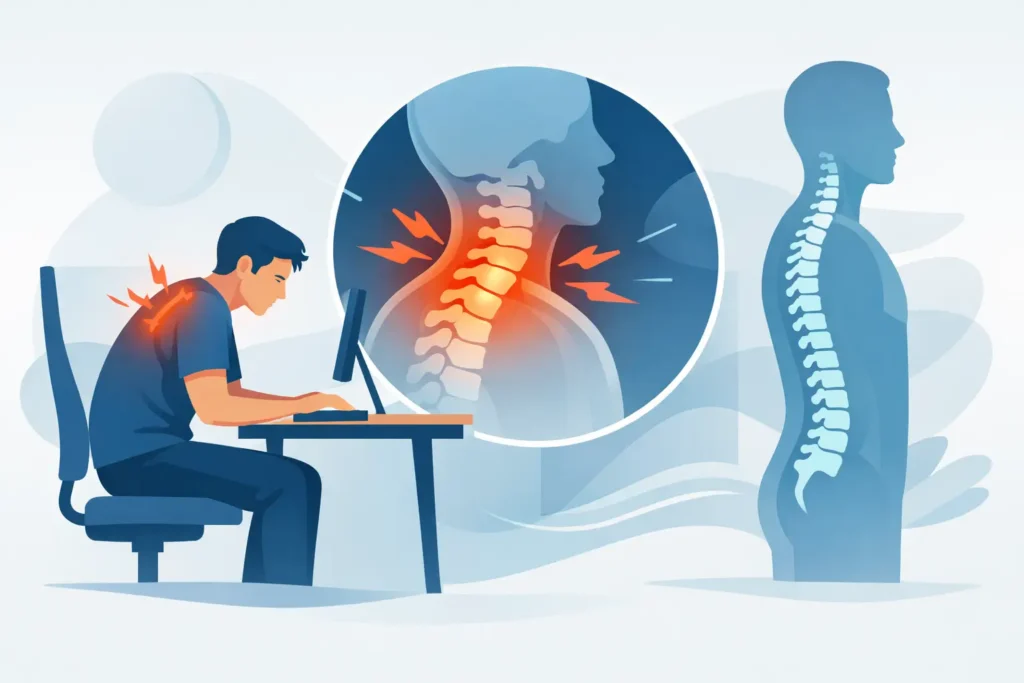
A long afternoon at a desk can leave you rubbing the base of your neck, shifting in your chair, or wondering why your low back feels tired before the day is over. If you have asked, why does poor posture hurt, the answer is not simply that you forgot to sit up straight. Pain usually develops because your body has been asked to support and move itself in an inefficient position for too long.
Posture is not about holding one rigid, picture-perfect pose all day. It is about how your spine, joints, muscles, and nervous system work together as you sit, stand, walk, lift, sleep, and exercise. When that system is repeatedly stressed, your body often responds with tightness, fatigue, irritation, and eventually pain.
Why Does Poor Posture Hurt Your Body?
Your spine has natural curves that help distribute the forces of everyday life. When you slump forward, round your shoulders, lean to one side, or hold your head in front of your shoulders for hours, those forces no longer spread evenly. Some tissues have to work harder while others become less active.
For example, looking down at a laptop or phone can draw the head forward. The muscles at the back of the neck and upper shoulders then work continuously to keep the head from falling farther forward. Over time, they may become sore, tight, and sensitive. Meanwhile, the joints and discs of the cervical spine may be placed under different pressures than they are designed to handle.
The same pattern can occur in the mid-back and low back. A collapsed sitting posture may increase strain through the lower back, shorten the muscles at the front of the hips, and reduce support from the core and gluteal muscles. Standing with most of your weight on one leg can also create uneven stress through the pelvis, hips, and low back.
Poor posture is rarely the only cause of pain. Previous injuries, repetitive work, stress, limited sleep, reduced activity, arthritis, pregnancy changes, and weak or underused muscles can all affect how the body tolerates certain positions. That is why two people can sit at similar desks and have very different symptoms.
The Muscles, Joints, and Nerves Behind the Pain
Posture-related pain often involves more than one structure. The body is adaptable, but adaptation has a cost when the same pattern is repeated day after day.
Muscles become overworked
Muscles are meant to alternate between effort and rest. When a position requires certain muscles to stay “on” for long periods, they can become fatigued and guarded. The upper trapezius muscles, muscles at the base of the skull, hip flexors, and low-back muscles commonly become overworked in people who spend long hours seated.
Muscle tension can feel like a dull ache, stiffness, knots, or a burning sensation. It may also limit how easily you can turn your head, reach overhead, or stand upright after sitting. Stretching can provide temporary relief, but it may not be enough if the underlying movement pattern and joint restrictions are still present.
Joints can become irritated or restricted
Spinal and extremity joints need regular, comfortable movement. When you repeatedly sit or stand in a limited position, some joints may move too little while others compensate by moving too much. This can contribute to stiffness, tenderness, and reduced range of motion.
Joint irritation does not always stay local. A stiff upper back, for instance, may cause the neck and shoulders to work harder during everyday movements. A restricted hip can influence how the pelvis and low back move. Looking at these relationships is often more useful than focusing only on the spot that hurts.
Nerves may become more sensitive
Nerves carry messages between your brain and body. Tight muscles, inflamed tissues, joint dysfunction, or disc-related changes can sometimes irritate nearby nerves. This may contribute to symptoms such as pain that travels into an arm or leg, tingling, numbness, or weakness.
Not every posture-related ache means there is nerve involvement. However, persistent radiating pain, numbness, progressive weakness, balance changes, or changes in bladder or bowel control deserve prompt medical evaluation. A thorough assessment helps determine whether symptoms are primarily muscular, joint-related, nerve-related, or a combination.
Common Signs Your Posture May Be Adding Stress
Postural strain does not look the same for everyone. It may show up gradually, especially after work, driving, caring for children, or exercising. Common patterns include:
- Neck pain, upper-back tightness, or shoulders that feel constantly elevated
- Headaches that begin near the neck or base of the skull
- Low-back aching that worsens with prolonged sitting or standing
- Hip tightness, uneven weight-bearing, or discomfort when walking
- Tingling, pain, or tension that travels into an arm, hand, leg, or foot
These symptoms are signals, not personal failures. Your body is asking for a change in load, movement, recovery, or support.
Why “Just Sit Up Straight” Is Not Enough
Trying to force yourself into a rigid upright position can create a different kind of tension. Healthy posture is dynamic. Even a well-organized sitting position becomes uncomfortable if you hold it for hours without moving.
A better goal is to change positions regularly and build capacity for the demands of your day. That may mean standing for a few minutes between tasks, taking a brief walk after meetings, adjusting your screen height, or using a headset instead of cradling a phone between your shoulder and ear. Small changes can reduce repetitive strain, but they work best when paired with a plan that addresses your individual limitations.
Your work setup matters, but it is not the entire story. An ergonomic chair cannot fully solve pain caused by a previous accident, a restricted spinal joint, weak postural muscles, or a movement habit that continues outside the office. Likewise, an active person can still have posture-related discomfort if their training, recovery, and daily positions are not well balanced.
A Whole-Person Approach to Posture-Related Pain
At Align Chiropractic and Wellness, care begins by listening to what your symptoms are like, when they occur, and how they affect your work, family life, sleep, and activities. Objective assessment can help identify areas of altered movement, postural imbalance, muscle tension, and joint dysfunction rather than assuming every patient needs the same solution.
Depending on your needs, a personalized plan may include chiropractic adjustments to support spinal or extremity joint motion, postural rehabilitation exercises, and instruction for movement at home. Some patients may benefit from spinal decompression, acupuncture, or guidance around nutrition, activity, and recovery habits. Regular re-evaluations help track whether your plan is improving function, not simply reducing discomfort for a day or two.
The goal is not to make you depend on perfect posture. It is to help your body move more comfortably, tolerate daily demands more effectively, and give you practical strategies that fit real life.
Simple Ways to Start Reducing Postural Strain
Begin with awareness, not perfection. Notice when symptoms build: after computer work, during a commute, while feeding a baby, after scrolling on your phone, or at the end of a workout. Those details can reveal the positions and activities your body is struggling to tolerate.
Create frequent movement breaks before pain becomes intense. A brief walk, gentle shoulder rolls, changing your seated position, or standing to take a call can interrupt prolonged loading. Keep screens closer to eye level when possible, and bring frequently used items within easy reach so you are not constantly twisting or leaning.
Build strength gradually as well. A targeted program may focus on deep neck muscles, upper-back support, core control, hips, and glutes, but the right exercises depend on your exam findings and health history. If an exercise sharpens pain, causes radiating symptoms, or leaves you significantly worse afterward, stop and seek guidance rather than pushing through.
Persistent pain is not something you have to accept as the price of work, parenting, or staying active. With a thoughtful assessment and a plan built around your body and goals, you can move toward less strain, more confidence, and a healthier relationship with everyday movement.