
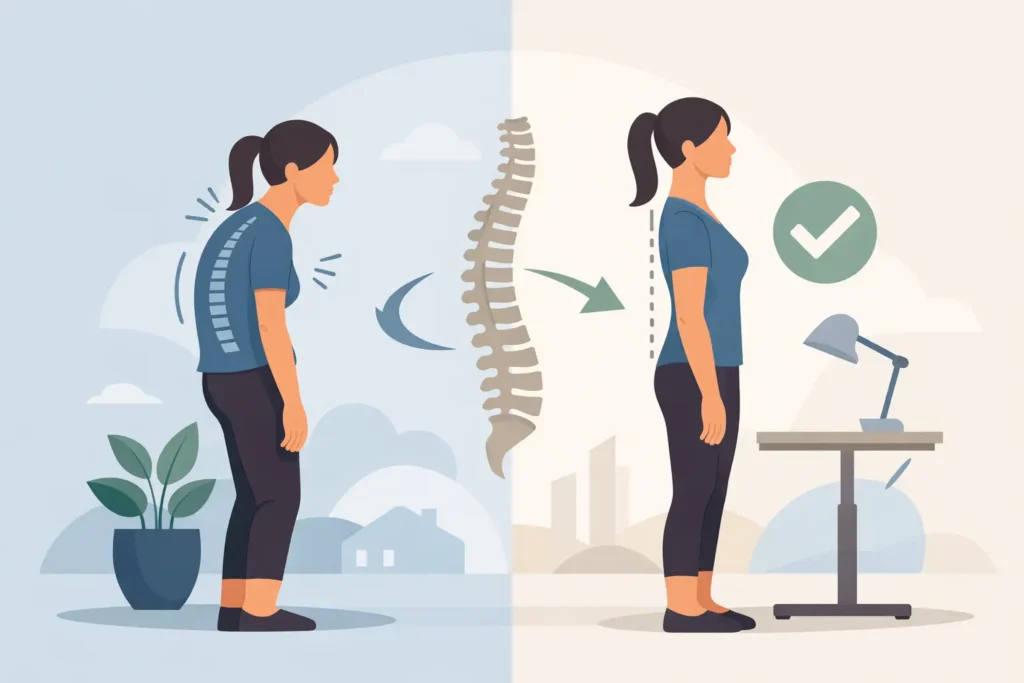
Standing in line at the grocery store, helping your child get ready, or working at a standing desk should not leave you shifting from foot to foot with an aching low back or tight neck. Learning how to improve standing posture is not about holding yourself stiffly all day. It is about giving your body a more balanced, supported position so your muscles and joints do not have to work overtime.
At Align Chiropractic and Wellness, we often see that posture concerns are connected to more than a reminder to “stand up straight.” Old injuries, long workdays, muscle weakness, foot mechanics, stress, and daily habits can all affect how your body carries itself. The most lasting changes come from understanding your individual patterns and practicing small, consistent adjustments.
What Good Standing Posture Actually Feels Like
Good standing posture is not a military stance with your chest forced up and your shoulders pulled back as far as they can go. That position can create unnecessary tension. Healthy alignment should feel steady, relaxed, and adaptable enough that you can move easily when you need to.
From the side, the ear, shoulder, rib cage, hip, knee, and ankle generally stack in a balanced relationship. Bodies are not perfectly symmetrical, and trying to make them so can be frustrating. The goal is to reduce obvious strain, such as a head consistently pushed forward, ribs flared upward, hips tipped dramatically forward, or most of your weight resting on one leg.
A useful test is to stand naturally in front of a mirror. Notice where your weight goes first. Are your toes gripping the floor? Are your knees locked? Does one hip drift out to the side? Awareness is not a diagnosis, but it is a helpful starting point for changing habits that may be contributing to discomfort.
How to Improve Standing Posture With Simple Cues
Start with your feet. Place them about hip-width apart, with your weight spread through the heel, the base of the big toe, and the base of the little toe on each foot. You do not need to press hard into the floor. Think of creating a stable, even foundation.
Next, keep a soft bend in your knees rather than locking them. Locked knees can encourage your pelvis to shift forward and may make standing feel more tiring. Allow your hips to settle over your ankles, then gently stack your rib cage over your pelvis. If you feel as if you are thrusting your ribs forward or tucking your tailbone aggressively, ease off. Neutral is usually quieter than people expect.
Let your shoulders rest rather than pinching them backward. A helpful cue is to imagine your collarbones widening. Then bring your head back so your ears are more centered over your shoulders, as if a string at the top of your head is giving you a light lift. Avoid tilting your chin upward. Your gaze should stay level and your jaw relaxed.
These four checkpoints can be used throughout the day:
- Keep weight distributed across both feet instead of hanging on one hip.
- Soften your knees and avoid gripping through your toes.
- Let your ribs settle over your pelvis without forcing a tuck or arch.
- Bring your head gently back over your shoulders, not tipped up or down.
Try a 10-second posture reset several times each day rather than attempting to maintain a perfect position for hours. Frequent, gentle corrections are more realistic and often more effective than rigid self-monitoring.
Build the Strength and Mobility Your Posture Needs
Posture is active. Your body needs enough mobility to move through a comfortable range and enough strength to maintain a supported position without fatigue. If your upper back is stiff, your chest muscles are tight, or your hips lack stability, simply telling yourself to stand taller may not solve the underlying issue.
For many people, a balanced routine includes upper-back mobility, chest opening, hip-flexor mobility, glute strength, and core control. Simple movements such as wall slides, gentle chest stretches, bridges, bird dogs, and controlled rows can be useful when they are appropriate for your body and performed correctly.
The key is not to collect as many exercises as possible. Choose a small program you can perform consistently, then progress it as your strength and control improve. If an exercise creates sharp pain, numbness, tingling, dizziness, or symptoms that travel into an arm or leg, stop and seek guidance from a qualified healthcare professional.
Breathing also matters. Many people hold their breath or breathe shallowly when stressed, which can make the neck, shoulders, and low back work harder. While standing, take a slow breath that expands through the sides and back of your rib cage. On the exhale, let your shoulders soften and notice whether your ribs can settle without force. This simple practice can reduce the tendency to brace unnecessarily.
Change the Habits That Pull You Out of Alignment
Even a strong body can become uncomfortable when it repeats the same position for too long. Standing posture is shaped by what happens before and after you stand: hours at a computer, looking down at a phone, carrying a child on one side, driving, or wearing shoes that do not support your needs.
If you stand at work, vary your position regularly. Shift one foot onto a low footrest for a short period, then switch sides. Take brief walking breaks when possible. If your job requires long stretches on hard flooring, supportive footwear and an anti-fatigue mat may help, although the right choice depends on your work environment and foot health.
When using a standing desk, screen height is especially important. Looking down for hours encourages the head and upper back to drift forward. Position your monitor so the top portion is near eye level, and keep frequently used items within easy reach. A standing desk is not automatically better if it causes you to stand still all day. Alternating between sitting, standing, and moving is usually the more body-friendly approach.
Why Pain Can Make Posture Harder to Change
Pain changes movement. If your low back hurts, you may lean away from the painful area. If your neck is tight, you may round your shoulders or push your head forward to find temporary relief. These adaptations are understandable, but over time they can reinforce an unbalanced pattern.
This is why posture care should not rely on a one-size-fits-all correction. A person recovering from an auto accident, managing pregnancy-related discomfort, or dealing with sciatica may need a different approach than someone whose main concern is desk-related neck tension. A thorough assessment can identify restrictions, muscle imbalances, joint irritation, and movement habits that may be influencing how you stand.
Chiropractic care, postural rehabilitation exercises, hands-on soft tissue work, acupuncture, and personalized home care may be considered as part of a broader plan, depending on your condition and goals. At Align Chiropractic and Wellness, care is guided by objective assessments and regular re-evaluations so your plan can adapt as your body responds.
When to Get Professional Support for Standing Posture
Consider scheduling an evaluation if posture changes are accompanied by persistent pain, frequent headaches, recurring numbness or tingling, weakness, pain after an accident, or symptoms that keep returning despite your efforts. You should also seek prompt medical attention for sudden severe pain, loss of bowel or bladder control, unexplained fever, or significant weakness.
For less urgent concerns, professional guidance can save you from guessing. An individualized exam can help determine whether your standing pattern is primarily related to work habits, mobility restrictions, strength deficits, prior injury, or a combination of factors. From there, a focused care plan can support both relief now and healthier movement over time.
Your posture does not have to be perfect to serve you well. Start with a more balanced stance, move often, and pay attention to the signals your body gives you. With consistent practice and the right support when needed, standing can feel less like something you have to endure and more like a comfortable part of your day.