A twinge when you bend to pick up a child, stiffness after a day at your desk, or a recurring ache during a workout can feel like isolated problems. Often, they are clues that the body is compensating somewhere else. This guide to functional movement screening explains how observing simple movement patterns can help identify those clues before they become bigger barriers to comfort, mobility, and everyday life.
Functional movement screening is not about judging how athletic you are or asking you to perform advanced exercises. It is a structured way to look at the quality of foundational movements such as squatting, stepping, reaching, balancing, and rotating. For people dealing with back pain, neck tension, headaches, sciatica, postural strain, or lingering discomfort after an auto accident, these patterns can offer useful insight into why the same area keeps becoming irritated.
What Functional Movement Screening Looks For
Your body rarely works in isolated pieces. A limitation in ankle mobility can change the way you squat. Weakness or poor control around the hips can place extra demand on the low back. Restricted movement through the upper back may contribute to forward-head posture and neck tension.
A functional movement screen looks for asymmetries, restricted range of motion, poor stability, and compensations. A compensation is a workaround the body uses to complete a task when one area is not moving, stabilizing, or coordinating well. It may get the job done for a while, but repeated compensation can increase stress on joints, muscles, and connective tissue.
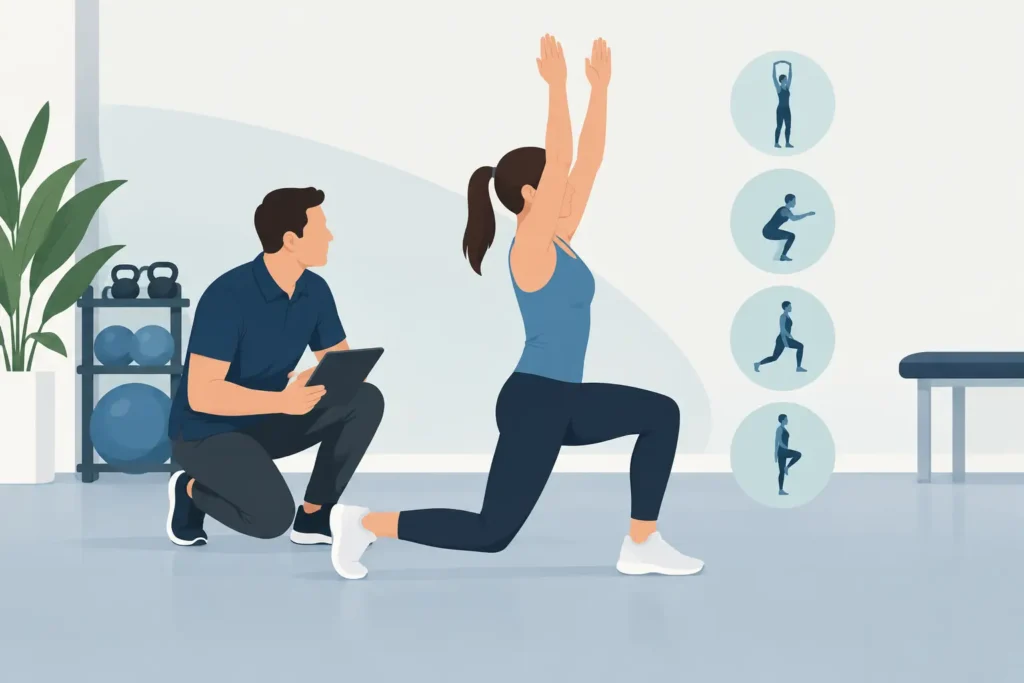
During a screening, a clinician may observe how you perform movements such as a bodyweight squat, lunge or step, single-leg balance, shoulder reach, hip hinge, and controlled trunk rotation. They are looking beyond whether you can complete the movement. The details matter: Does one knee collapse inward? Does one hip shift? Does your low back round or overarch? Can you raise both arms equally? Does a certain movement reproduce pain?
The goal is to create a clearer starting point for care. Instead of guessing that every low back problem needs the same solution, your provider can connect your symptoms, movement habits, posture, daily demands, and examination findings into a more personalized plan.
Why Pain Does Not Always Point to the Cause
Pain deserves attention, but the painful area is not always the only area that needs care. Someone with neck pain, for example, may also have limited upper-back mobility, weak postural endurance, stress-related muscle tension, or a workstation setup that keeps their head forward for hours each day. A person with knee discomfort may need support at the knee while also improving hip control or ankle movement.
This does not mean every pain issue comes from poor movement. Arthritis, disc injuries, nerve irritation, acute trauma, inflammatory conditions, and other health concerns require careful evaluation. Functional movement screening is one useful assessment tool, not a standalone diagnosis or a substitute for medical care when symptoms are serious.
A thoughtful provider combines movement findings with your health history, symptoms, neurological and orthopedic testing when appropriate, and your response to care. That fuller picture helps determine whether chiropractic care, rehabilitation exercises, acupuncture, decompression, home care, referral, or a combination of approaches makes sense.
A Guide to Functional Movement Screening for Everyday Life
For most patients, the value of screening is practical. It can show why certain daily tasks feel harder than they should and help prioritize the changes most likely to support relief.
Consider a working professional with recurring low back tightness. Their screen may reveal that they have difficulty hinging at the hips and rely on rounding through the lower back when reaching toward the floor. Rather than only treating the tightness, a care plan may include hands-on care for restricted joints and soft tissues, instruction in a safer hip-hinge pattern, exercises to build hip and core control, and simple ways to break up prolonged sitting.
For a parent in pregnancy or the postpartum period, screening may focus on comfort, balance, pelvic and spinal mechanics, and how the body responds to changing loads. The appropriate approach is different from training for a race, but the same principle applies: understand how the individual moves, then offer support that matches their needs and goals.
For someone recovering after a car accident, movement patterns can be affected by pain, guarding, stiffness, or reduced confidence in movement. The process should be gentle and adjusted to the stage of recovery. Pushing through sharp pain is not the objective. Restoring comfortable motion and control over time is.
What Happens During a Screening
A functional movement screening typically begins with a conversation. Your clinician should ask where you hurt, when symptoms began, what makes them better or worse, and how the problem affects sleep, work, exercise, family life, and other routines. Your goals matter too. Relief may be the immediate priority, while returning to gardening, lifting at the gym, or playing with your children may be the outcome you care about most.
Next comes observation and testing. You may be asked to move slowly through several positions while the clinician watches alignment, balance, mobility, coordination, and side-to-side differences. Some findings are visual, while others are measured through range-of-motion testing, posture assessment, strength or stability checks, and orthopedic or neurological exams when indicated.
The best screenings are not one-and-done events. Your body changes as pain settles, mobility improves, and you practice new habits. Regular re-evaluations allow your care plan to evolve. A movement limitation that was appropriate to address in the first few visits may no longer be the priority a few weeks later.
How Screening Findings Shape Care
A screen should lead to specific, understandable next steps. If the findings show restricted spinal movement and poor postural endurance, care may include chiropractic adjustments, targeted rehabilitation exercises, and home strategies for desk posture. If a shoulder restriction is affecting how you reach overhead, the plan may include extremity adjustments, mobility work, and exercises that improve control around the shoulder blade.
Not every finding needs to be corrected immediately. Some asymmetries are harmless, and people can move differently without pain. What matters is whether a pattern is connected to your symptoms, goals, injury history, and ability to function. This is where clinical judgment matters more than chasing a perfect score.
Home care is also part of the process. A few well-chosen exercises done consistently are often more helpful than a long routine that never fits into your schedule. Your provider may also discuss sleep position, lifting mechanics, hydration, nutrition, stress management, or ways to organize your workspace. Whole-person care recognizes that healing and resilience are influenced by more than what happens during an appointment.
When to Seek a More Thorough Evaluation
A movement screen can be especially helpful if you have recurring pain, feel uneven or unstable during exercise, have plateaued after trying general stretching, or want to return to activity after an injury. It is also useful for people who are not in severe pain but notice stiffness, poor posture, reduced balance, or declining confidence in everyday movement.
However, some symptoms call for prompt medical evaluation rather than self-testing or routine exercise. Seek urgent care for severe or worsening weakness, numbness in the groin area, loss of bowel or bladder control, unexplained fever, significant trauma, chest pain, or sudden symptoms that feel unusual or alarming. A qualified clinician can help determine the right next step when the cause of pain is unclear.
At Align Chiropractic and Wellness, movement assessment can be part of a personalized approach to finding the drivers behind discomfort and creating a realistic path forward. The aim is not simply to get you through the next day with less pain. It is to help you move with greater comfort, confidence, and capacity for the life you want to live.
If your body has been sending the same message through recurring pain, stiffness, or limitation, listening more closely to how you move may be a meaningful place to begin. A personalized evaluation can turn vague frustration into clear, manageable next steps.