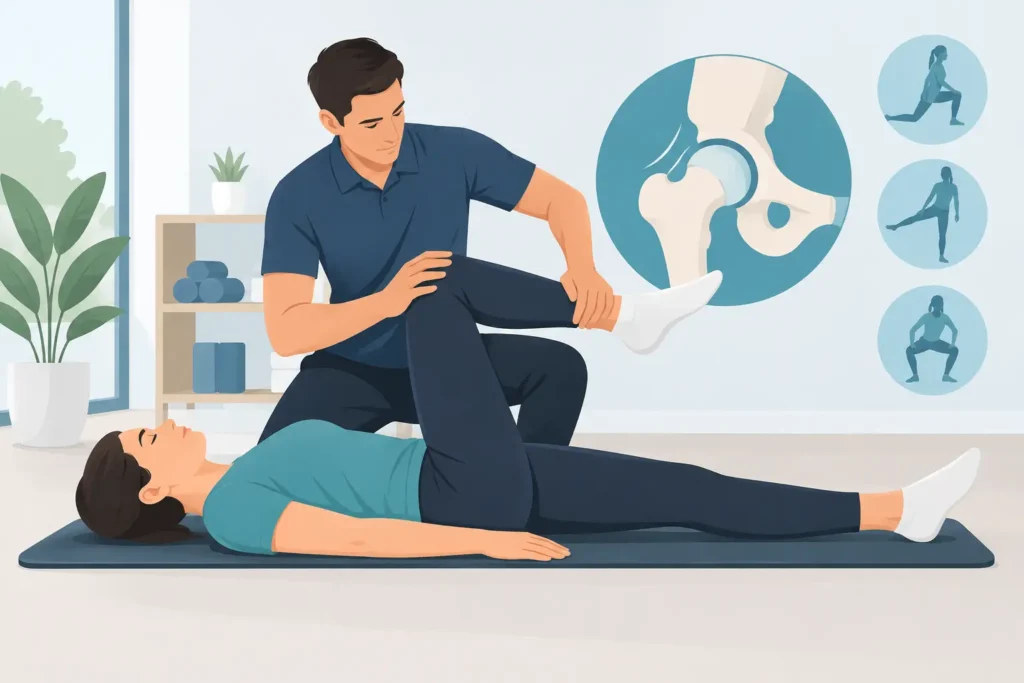
Hip stiffness rarely stays only in the hip. It can change how you walk, sit, squat, climb stairs, exercise, or even get comfortable in bed. This guide to hip mobility assessment explains what clinicians look for, why limited motion can affect the low back and knees, and when a personalized evaluation can help you move with more confidence.
Why Hip Mobility Deserves Attention
Your hips are designed to be mobile, stable, and strong. The ball-and-socket joint needs enough movement to let you step, bend, rotate, and change direction, while the surrounding muscles and connective tissues provide control. When one piece of that system is not working well, your body often finds a workaround.
That workaround may show up as low back tightness after a long workday, discomfort when getting out of the car, knee irritation during squats, or a stride that feels uneven while walking. Some people notice a pinching feeling at the front of the hip. Others feel stiffness in the outer hip, groin, glute area, or lower back instead.
Limited hip mobility does not automatically mean something is seriously wrong, and having a large range of motion is not always the goal. A dancer and a desk-based professional need different amounts of movement for daily life. What matters most is whether your hips move well enough for your body, your activities, and your goals without pain or compensation.
What a Hip Mobility Assessment Looks At
A useful assessment is more than a quick flexibility test. At Align Chiropractic and Wellness, the goal is to understand how your hips function within the rest of your body, including your pelvis, spine, knees, posture, movement habits, and current symptoms.
Your Health History and Daily Demands
The assessment starts with listening. When did the stiffness or pain begin? Did it follow an auto accident, a new workout routine, pregnancy, a fall, a change in work demands, or a gradual increase in sitting? Does the discomfort occur while walking, running, standing, sleeping, or going from sitting to standing?
These details matter because similar symptoms can have different drivers. A hip that feels tight after sitting may be affected by prolonged positioning, muscle tension, reduced joint motion, or a low back issue referring discomfort into the hip region. An active adult with pain during deep squats may need a different approach than someone whose symptoms began after a collision.
Posture, Walking, and Movement Patterns
Next, a clinician may observe how you stand, walk, squat, step, bend, or balance on one leg. This is not about judging your form. It is about identifying patterns that may be placing extra stress on certain areas.
For example, one foot may turn outward during walking, one side of the pelvis may shift during a squat, or the low back may round or arch excessively when the hips should be contributing more movement. These patterns can be protective responses to pain, weakness, stiffness, or poor motor control. They can also be habits that developed gradually over time.
Active and Passive Range of Motion
Hip mobility is typically assessed in several directions: flexion, extension, internal rotation, external rotation, abduction, and adduction. In plain language, that means looking at how well you can bring your knee toward your chest, move the leg behind you, rotate the thigh inward or outward, and move the leg away from or toward your midline.
Active motion shows what you can control on your own. Passive motion, where a clinician gently guides the leg, can offer different information about joint motion and tissue resistance. Comparing right and left sides is helpful, but symmetry is not the only measure of health. The quality of movement, your symptoms, and the end feel of the motion all matter.
Strength, Stability, and Control
A hip can be flexible but poorly controlled. It can also feel stiff because the body does not feel stable enough to allow more motion. That is why a complete guide to hip mobility assessment should include strength and control, not just stretching.
Your provider may assess glute strength, trunk stability, balance, and the ability to control the knee and pelvis during single-leg movements. Weakness or delayed muscle activation can change how forces travel through the hip, knee, and low back. Improving mobility without building control may provide only temporary relief.
Simple At-Home Observations That Can Be Helpful
You do not need to force yourself through aggressive tests at home. However, paying attention to everyday movements can give you useful information to share at an appointment.
Notice whether you have trouble putting on shoes and socks, crossing one leg over the other, rising from a low chair, getting in or out of a vehicle, taking a longer stride, or turning quickly. Also note whether one side feels different from the other, and whether discomfort is sharp, pinching, aching, numb, or tingling.
A gentle bodyweight squat can be informative if it is comfortable. Watch for a painful pinch in the front of the hip, a major shift to one side, knees collapsing inward, heels lifting, or low back discomfort before you reach a comfortable depth. These observations are not a diagnosis. They are simply clues that can help guide a professional evaluation.
Avoid pushing through sharp pain, forcing a stretch, or repeatedly testing a movement that causes symptoms. More range is not better if you have to compensate, hold your breath, or provoke pain to get it.
Common Reasons Hips Feel Tight
Hip tightness is often blamed on sitting, and sitting can contribute. Long periods in one position may leave the hip flexors and surrounding tissues feeling restricted while the glutes become less active. Still, sitting is rarely the entire story.
A past injury, joint irritation, arthritis-related changes, pregnancy-related pelvic changes, spinal dysfunction, repetitive work positions, reduced strength, and training errors can all influence hip movement. Low back problems may also mimic hip discomfort, while hip dysfunction can contribute to extra strain in the low back.
This overlap is why self-diagnosis can be frustrating. Stretching may help one person feel better and make another person feel more irritated. The right strategy depends on whether the main limitation involves joint motion, muscle tension, stability, movement coordination, inflammation, or a combination of factors.
How Personalized Care Can Support Better Movement
After an assessment, care should match what your body needs rather than follow a one-size-fits-all routine. For some patients, chiropractic adjustments to the spine, pelvis, or extremities may help address restricted joint motion. Others may benefit from targeted rehabilitation exercises to improve hip strength, postural control, and movement patterns.
Hands-on care, spinal decompression when appropriate, acupuncture, and guided home exercises may also be part of a broader plan based on your condition and goals. If daily habits are contributing, practical changes to workstation setup, sleep position, activity pacing, nutrition, or recovery routines can support progress outside the clinic.
Regular re-evaluations are valuable because your needs can change as pain improves and movement returns. Early in care, the focus may be reducing irritation and restoring comfortable motion. Later, the emphasis may shift toward strength, balance, endurance, and returning to the activities that matter to you.
When Hip Symptoms Need Prompt Medical Attention
Not every hip concern should be managed with mobility work. Seek prompt medical evaluation for severe pain after a fall or accident, an inability to bear weight, visible deformity, fever with hip pain, sudden swelling or redness, unexplained weight loss, or progressive numbness or weakness. New loss of bowel or bladder control is an emergency.
If hip or groin pain persists, interrupts sleep, worsens despite rest, or limits your normal activities, a professional assessment is a sensible next step. Getting clear answers early can help prevent compensations from becoming more established.
Your body should not have to choose between staying active and staying comfortable. A thoughtful hip mobility assessment can identify the movement restrictions and compensation patterns behind your symptoms, then create a realistic path toward steadier, more comfortable movement. If your hips, low back, or knees are holding you back, scheduling a personalized evaluation can be a positive first step toward feeling more at home in your body.