
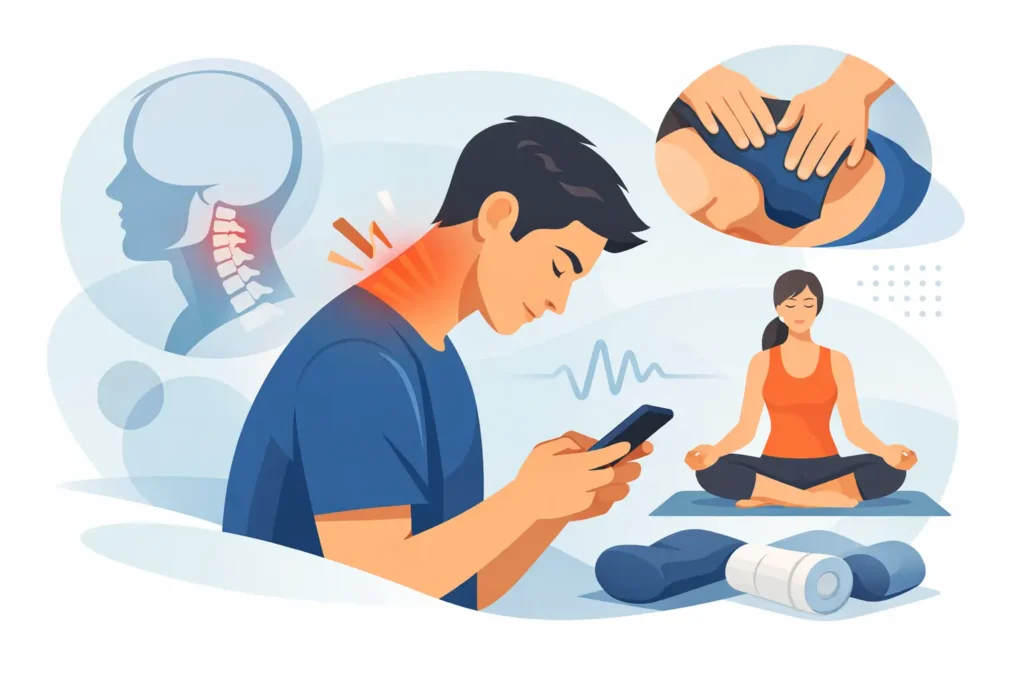
You do not have to spend all day on your phone to feel the effects of neck pain from text neck. For many adults, it shows up after ordinary routines – answering emails, scrolling at night, working on a laptop, or looking down during long stretches of the day. What starts as mild stiffness can turn into headaches, shoulder tension, and a neck that never seems to fully relax.
Text neck is not just a trendy phrase. It describes a very real pattern of postural stress that can affect muscles, joints, and nerves over time. When your head drifts forward and down repeatedly, the structures in your neck have to work much harder to support it. That extra strain can build slowly, which is why many people ignore it until the discomfort starts interfering with sleep, focus, exercise, or daily movement.
What neck pain from text neck really means
Your head is designed to balance over your shoulders. When that alignment is lost, the load on your neck increases. Looking down at a phone, tablet, or laptop for extended periods places the cervical spine in a flexed position, often combined with rounded shoulders and a collapsed upper back.
That posture changes more than appearance. It can irritate joints in the neck, overload muscles that were never meant to hold tension all day, and reduce healthy movement through the upper spine. Some people feel an ache at the base of the neck. Others notice tightness across the shoulders, pain between the shoulder blades, or headaches that begin in the neck and travel upward.
This is also why text neck can feel different from person to person. One patient may mainly notice stiffness in the morning. Another may have sharp pain turning the head while driving. Someone else may feel burning tension across the upper back after desk work. The underlying pattern is similar, but the exact symptoms depend on posture habits, stress levels, work setup, injury history, and overall spinal health.
Common signs that posture is becoming a problem
Neck pain from text neck often develops gradually. At first, you may simply feel sore after a long day. Over time, the body starts adapting to those positions, and that is when symptoms tend to become more frequent.
Common signs include recurring neck stiffness, tension headaches, tenderness at the base of the skull, shoulder tightness, reduced range of motion, and discomfort when looking up after spending time looking down. Some people also notice tingling into the arm or hand, especially if irritated muscles and joints begin affecting nearby nerves.
Jaw tension, fatigue, and even shallow breathing can show up as part of the same postural pattern. When the head moves forward, the upper back often rounds and the rib cage loses some mobility. The body then compensates in ways that can create strain well beyond the neck itself.
Why rest alone does not always fix it
It is tempting to assume that a little stretching and a weekend away from screens will solve the issue. Sometimes a mild flare-up does settle down with rest. But if poor mechanics are repeated every day, symptoms usually return.
That is because text neck is not only a pain problem. It is also a movement and loading problem. If the joints in the neck are restricted, the upper back is stiff, the shoulders are rolling forward, and the supporting muscles are weak or overworked, the body keeps getting pulled back into the same pattern.
This is where a more complete approach matters. Lasting improvement often requires reducing irritation, restoring mobility, retraining posture, and improving the way your body handles daily demands. Pain relief is important, but relief without correction tends to be temporary.
How neck pain from text neck is assessed
A good evaluation should look beyond where it hurts. If you come in with neck tension, the goal is not just to point to the sore spot. The goal is to understand why it keeps happening.
That usually includes reviewing your symptoms, daily activities, workstation habits, sleep position, and any history of injuries or headaches. Objective assessment may involve checking posture, range of motion, spinal alignment, joint restriction, muscle tension, and neurologic findings when needed. In many cases, the upper back, shoulders, and even jaw mechanics deserve attention because they can contribute to the same pattern.
This kind of assessment helps separate text neck from other causes of neck pain. Disc issues, arthritis, whiplash injuries, and nerve irritation can overlap with posture-related symptoms. That is one reason self-diagnosis can be misleading. Two people may both say, “My neck hurts,” but the care they need may be very different.
What helps relieve text neck symptoms
The most effective care is usually personalized, because the same symptom can come from different combinations of tension, restriction, weakness, and daily habits. Still, several approaches tend to help when they are matched to the individual.
Hands-on care can reduce joint restriction and muscle guarding in the neck and upper back. Chiropractic adjustments, when appropriate, may help improve motion in areas that have become stiff from prolonged poor posture. Soft tissue work and targeted stretching can calm overactive muscles that are trying to stabilize a misaligned position all day.
Rehabilitation is just as important. Specific postural exercises can strengthen the muscles that support better alignment, especially in the deep neck flexors, upper back, and shoulder girdle. This matters because many people with text neck are not simply tight. They are tight in some areas and weak in others.
Home care also plays a major role. Small changes often make a big difference, such as raising your screen closer to eye level, taking movement breaks during computer work, avoiding long periods of looking down at your lap, and using a pillow that supports neutral neck posture. If stress is contributing to clenching and shoulder tension, recovery may also involve breathing work, sleep support, and overall nervous system regulation.
For some patients, acupuncture can be a helpful addition for muscle tension and pain relief. If inflammation, poor recovery habits, or broader lifestyle factors are part of the picture, guidance around nutrition and wellness habits may support better healing too. A whole-person plan tends to work better than a single quick fix.
When you should not ignore neck pain
Not every sore neck is an emergency, but persistent or worsening symptoms deserve attention. If your pain keeps returning, limits your movement, disrupts sleep, or starts causing headaches on a regular basis, it is time to get it evaluated.
You should also seek care promptly if neck pain includes numbness, tingling, weakness, pain traveling into the arm, dizziness, or symptoms after a car accident or fall. Those situations may involve more than simple postural strain and should not be brushed off as just screen fatigue.
Even when the cause is primarily text neck, early care is often easier than waiting. Mild dysfunction is usually more straightforward to correct than a pattern that has been building for months or years.
The goal is not perfect posture every second
Many people worry they need to sit perfectly all day to avoid pain. That is not realistic, and it is not the goal. The body does well with variety, movement, and balanced support. The bigger issue is staying in the same stressed position for too long without enough strength, mobility, or recovery to offset it.
A better target is sustainable posture. That means setting up your environment so your body is not fighting unnecessary strain, building strength where support is lacking, and addressing restrictions before they become chronic. It also means recognizing that posture is connected to lifestyle. Long work hours, stress, poor sleep, and inactivity can all make text neck symptoms worse.
At Align Chiropractic and Wellness, that is why care is centered on more than symptom relief alone. A personalized plan may include hands-on treatment, postural rehabilitation, home exercises, and regular re-evaluations so progress is measured and care evolves as your body improves.
If your neck has been asking for attention every time you check your phone or finish a workday, listen to it. The sooner you address the pattern behind the pain, the easier it is to move, work, and rest with less tension and more confidence.