
When your back tightens up after a long workday, your neck starts triggering headaches, or sciatic pain makes simple movement feel complicated, the question often comes up fast: chiropractor or physical therapy? Most people are not looking for a debate. They want to know what will actually help them feel better, move better, and stay better.
The honest answer is that both can play a valuable role. The better question is not which one is universally best. It is which approach fits your condition, your goals, and what your body needs right now.
Chiropractor or physical therapy: what is the difference?
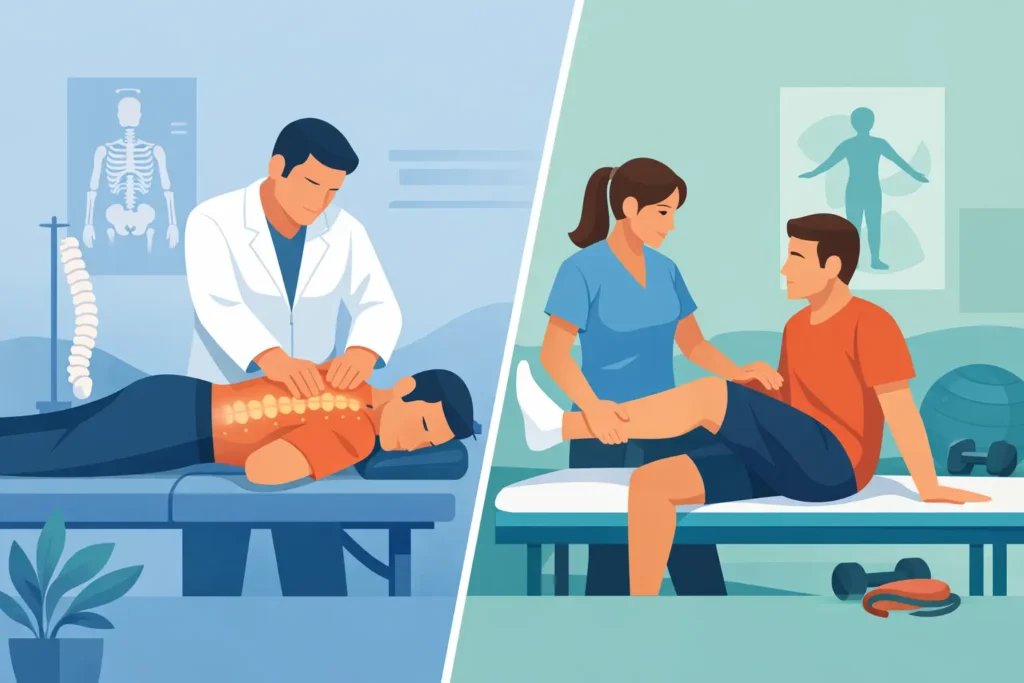
Chiropractic care focuses on how the spine, joints, muscles, and nervous system work together. A chiropractor looks for movement restrictions, postural imbalances, joint dysfunction, and mechanical stress that may be contributing to pain, tension, stiffness, or recurring flare-ups. Treatment often includes spinal or extremity adjustments, soft tissue work, mobility support, and corrective exercises.
Physical therapy typically centers on restoring function after injury, surgery, or physical limitation. A physical therapist often guides patients through therapeutic exercise, mobility training, strength work, balance training, and movement retraining to improve how the body performs during daily activities.
There is overlap between the two, especially when it comes to exercise, rehab, and musculoskeletal pain. That is why people can get confused. But the emphasis is often different. Chiropractic care commonly starts with joint mechanics, alignment, posture, and nervous system function. Physical therapy often starts with functional capacity, weakness, movement limitations, and tissue recovery.
Neither approach is automatically better in every case. It depends on the source of the problem.
When a chiropractor may be the better fit
If your pain seems tied to stiffness, posture, repetitive strain, spinal tension, or restricted movement, chiropractic care may be a strong place to start. This is especially true for issues like neck pain, mid-back tightness, low back pain, tension headaches, posture-related discomfort, and some forms of sciatic irritation.
For many adults, the problem is not just pain. It is the pattern behind the pain. Hours at a desk, stress, poor sleep posture, old injuries, pregnancy-related body changes, or an auto accident can all affect how the spine and supporting muscles function. When joints are not moving well and the body starts compensating, pain often becomes the message people notice last.
A chiropractor can assess those movement patterns and look for underlying mechanical stress. Care may include adjustments to improve joint motion, postural rehabilitation exercises, spinal decompression when appropriate, and at-home guidance that supports recovery between visits.
This can be especially helpful when someone says, “It keeps coming back,” or “I feel stuck and tight all the time,” rather than, “I just need to rebuild after surgery.” In those situations, improving spinal and joint function may change the way the body handles stress and movement day to day.
When physical therapy may make more sense
Physical therapy can be an excellent option when the main goal is rebuilding strength, restoring function after surgery, improving balance, or progressing through a structured rehab plan after a major injury. If someone has significant muscle weakness, major mobility loss, gait issues, or a condition that clearly requires graded exercise progression, physical therapy may be the right fit.
It is also commonly recommended after orthopedic procedures, sports injuries, or periods of deconditioning where the body needs step-by-step retraining. In those cases, targeted therapeutic exercise is often the centerpiece of care.
That said, many people assume physical therapy is only for severe cases, and that is not accurate. It can also help with less dramatic pain problems, especially when weakness, instability, or poor movement habits are driving symptoms.
The real issue: what is causing your pain?
This is where many people get stuck. They choose care based on the name of the profession instead of the nature of their problem.
Two people can both have low back pain and need very different care. One may have joint restriction, poor posture, and recurring tension from long hours at a desk. Another may have reduced hip strength, poor core control, and movement patterns that overload the lumbar spine. One may respond quickly to hands-on care and mobility restoration. The other may need a heavier rehab focus.
That is why a thoughtful evaluation matters. The most helpful provider is the one who looks beyond the symptom and assesses what is actually contributing to it. Objective testing, movement assessment, posture evaluation, orthopedic and neurologic screening, and regular re-evaluations all help shape a smarter plan.
Can chiropractic care include rehab?
Yes, and that matters more than many people realize.
Modern chiropractic care is often far more comprehensive than people expect. It is not limited to adjustments. In a patient-centered setting, chiropractic care may include corrective exercise, postural retraining, spinal decompression, acupuncture, home exercise instruction, and lifestyle support that helps address why the issue developed in the first place.
That blended approach can be especially useful for people who want pain relief but also want to fix the habits and movement patterns that keep feeding the problem. If a person gets short-term relief but never improves strength, posture, or body mechanics, the pain often returns.
A more complete care plan addresses both. It helps restore movement while teaching the body how to support that improvement.
How to decide between chiropractor or physical therapy
Start by thinking about what your body is telling you, not just what your schedule or internet search history says.
If you feel stiff, compressed, misaligned, posture-weary, or limited in how your spine and joints move, chiropractic care may be the more natural first step. If you are recovering from surgery, dealing with major weakness, or need a progressive functional rehab program, physical therapy may be more appropriate.
But there is another layer. You should also consider the style of care you want. Do you want hands-on treatment plus a personalized home plan? Do you want someone looking at posture, daily habits, nervous system stress, and joint mechanics along with exercises? Do you want regular re-evaluations to see if the plan is working and adjust it when needed?
Those questions matter because the right care is not just about credentials. It is about fit.
What patients in pain often need most
Most adults dealing with neck pain, headaches, sciatica, or recurring back pain do not just need a label. They need someone to listen carefully, examine thoroughly, explain clearly, and map out next steps that make sense.
That is why individualized care is so important. A cookie-cutter plan can miss too much. The body is not a checklist. Your work demands, stress level, activity history, sleep position, pregnancy, prior injuries, and accident history all affect how pain develops and how recovery unfolds.
At Align Chiropractic and Wellness, that whole-person perspective is central to care. The goal is not simply to quiet symptoms for a few days. It is to identify the root causes of pain and dysfunction, support healing with hands-on treatment and rehabilitation, and give patients practical tools to maintain progress at home.
A few situations where the answer may be clearer
If you were recently in an auto accident, chiropractic care can be especially helpful for evaluating spinal alignment, soft tissue strain, whiplash-related restriction, and the mechanical stress that often follows even a low-speed collision.
If you are pregnant and dealing with pelvic discomfort, back pain, or postural strain, a chiropractor trained in pregnancy care may offer gentle, tailored support that fits the changes your body is going through.
If headaches seem to start in the neck and shoulders, or your low back pain worsens after sitting, standing, or lifting, a chiropractic evaluation may uncover joint and postural issues that are not obvious from symptoms alone.
If you have had a surgery, a major tear, or clear loss of function that calls for staged strengthening and retraining, physical therapy may be the more direct path.
The key is not forcing every problem into one category. It is getting assessed by a provider who can tell the difference.
Pain changes how you work, sleep, exercise, parent, and show up in your daily life. You deserve care that looks at the full picture and gives you a plan built around your body, not a generic protocol. If you are weighing chiropractor or physical therapy, the next best step is a thorough evaluation that helps you stop guessing and start moving toward real improvement.