
If your shoulders keep rounding forward by lunchtime or your neck feels tight after a day at a desk, posture is not just about how you look. It affects how you breathe, how your joints move, and how much strain builds up in your neck, mid-back, low back, and even your hips. The best exercises for posture are not usually the hardest ones. They are the ones that restore balance to muscles that have become stiff, weak, or overworked through daily habits.
That matters because poor posture rarely comes from one single problem. For some people, the main issue is a stiff chest and upper back. For others, it is weak glutes, poor core control, pregnancy-related changes, or compensation after an injury or auto accident. The goal is not to force yourself into a rigid “sit up straight” position all day. The goal is to build a body that can hold better alignment with less effort and less pain.
What makes posture get worse
Posture changes gradually. Long hours at a computer, time on a phone, driving, stress, old injuries, and repetitive lifting can all shift how your body organizes itself. When that happens, certain muscles tend to tighten while others stop doing their share of the work.
A common pattern is forward head posture with rounded shoulders and a stiff upper back. Another is an exaggerated arch in the low back paired with weak abdominal and glute support. Both patterns can contribute to headaches, neck pain, shoulder tension, low back discomfort, and reduced movement quality.
This is why posture exercises work best when they address both mobility and stability. If you only stretch what feels tight, the problem often returns. If you only strengthen without improving mobility, your body may keep moving around restrictions rather than through them.
Best exercises for posture at home
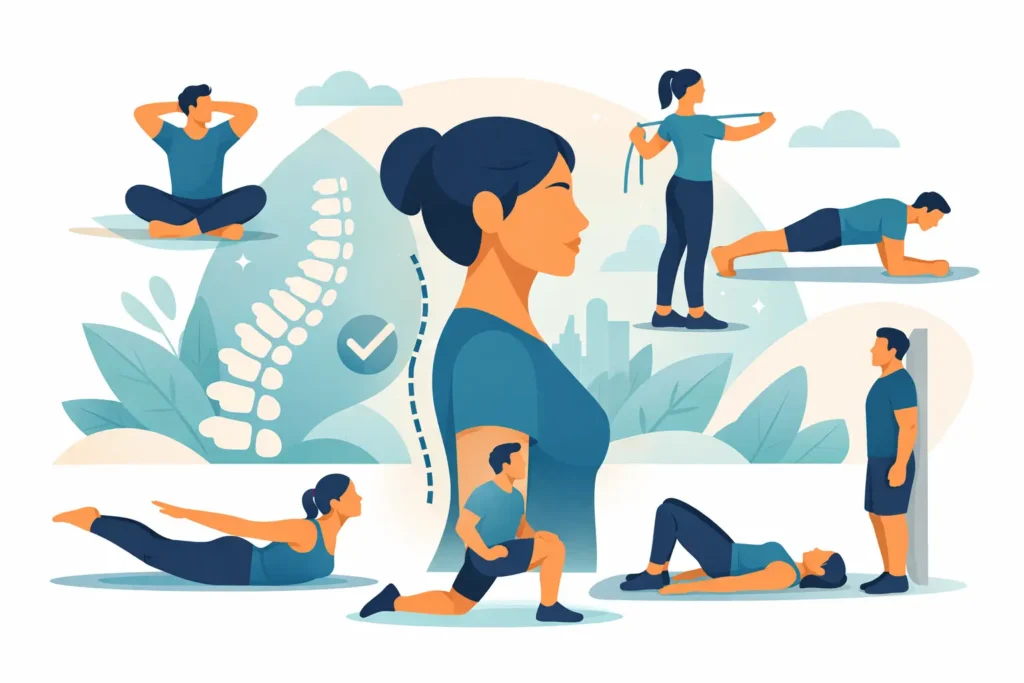
The following movements are often helpful because they target the areas most commonly involved in postural strain. They are general recommendations, not a one-size-fits-all prescription. If an exercise increases pain, causes numbness or tingling, or feels wrong for your body, it should be modified or replaced.
Chin tucks for forward head posture
Chin tucks help retrain the deep neck flexors, which often become underactive when the head drifts forward. Sit or stand tall, keep your eyes level, and gently draw your head straight back as if you are trying to make a double chin. Do not tip your head up or down. You should feel a mild effort deep in the front of the neck, not a strong strain.
This is a small movement, and that is part of why it is effective. It teaches control rather than force. If you spend most of your day at a desk, a few sets of slow chin tucks can help reduce the habit of reaching your head toward your screen.
Doorway pec stretch for rounded shoulders
Tight chest muscles can pull the shoulders forward and make it harder to open through the front of the body. A doorway pec stretch can help restore that space. Place your forearm on a door frame with the elbow around shoulder height, then gently step through until you feel a stretch in the chest and front of the shoulder.
The key is to keep the stretch controlled. If you crank into it, your body may guard against the movement. A gentle stretch held with steady breathing is usually more productive than an aggressive one.
Thoracic extension to improve upper back mobility
Many people with poor posture do not actually have a shoulder problem first. They have an upper back that does not extend well, so the shoulders and neck compensate. Thoracic extension over a foam roller or even over the back of a sturdy chair can help improve mobility in the mid-back.
Support your head, keep your ribs from flaring excessively, and extend gently over the area that feels stiff. This should feel like a controlled opening through the upper back, not a sharp bend through the low back. Better thoracic mobility often makes upright posture feel more natural instead of forced.
Wall angels for shoulder and upper back control
Wall angels combine awareness, mobility, and muscle activation. Stand with your back against a wall, knees soft, and try to keep your head, upper back, and arms in contact as you slowly move your arms up and down in a goalpost-like position.
This exercise can be surprisingly humbling. If it feels difficult, that does not mean you are doing it wrong. It usually means there are real restrictions or weaknesses that need attention. Move slowly and stay within a range you can control without shrugging or arching your back.
Rows to strengthen the muscles that support alignment
Rows are one of the best exercises for posture because they strengthen the upper back muscles that help counterbalance prolonged forward positioning. You can do them with a resistance band, cable machine, or light dumbbells. Focus on pulling your shoulder blades back and slightly down without overextending your low back.
A row should not turn into a neck exercise. If your shoulders creep up toward your ears, reduce the resistance and reset. Stronger scapular stabilizers can make a significant difference in how your neck and shoulders feel by the end of the day.
Glute bridges for pelvic support
Posture is not only about the neck and shoulders. Your pelvis and hips play a major role in how your spine stacks above them. Glute bridges strengthen the glutes, which often become underused when people sit for long periods. Lie on your back with knees bent, feet flat, and lift your hips by pressing through your heels.
You should feel the work in your glutes more than your low back. If your hamstrings cramp or your back takes over, the setup may need to be adjusted. Stronger glutes can help reduce excessive stress on the low back and support a more stable standing posture.
Dead bugs for core stability
A stable core helps you maintain alignment while your arms and legs move. Dead bugs are excellent for teaching that kind of control. Lie on your back with knees and hips bent to 90 degrees and arms reaching upward. Slowly lower one arm and the opposite leg while keeping your trunk steady, then return and switch sides.
This is not about speed. It is about keeping the ribs, pelvis, and spine organized while your limbs move. For many people, improved posture starts when the body learns not to compensate with the low back during everyday tasks.
How often should you do posture exercises?
Consistency matters more than intensity. For most people, doing a small routine four to six days per week works better than one long session done occasionally. Even 10 to 15 minutes a day can create meaningful change when the exercises match the actual problem.
It also helps to think beyond exercise sessions. If you do a great routine in the morning but then stay in one strained position for eight hours, progress will be slower. Short movement breaks, workstation changes, and body awareness throughout the day make these exercises more effective.
When exercises alone are not enough
Posture-related discomfort can overlap with other issues, including disc problems, joint irritation, pregnancy-related changes, nerve tension, scoliosis, old injuries, or compensation after a car accident. In those situations, the best exercises for posture may still help, but they may not be enough on their own.
That is where an assessment matters. A personalized plan can identify whether the real driver is stiffness, weakness, movement asymmetry, pain avoidance, or a combination of factors. At Align Chiropractic and Wellness, that process often includes objective testing, hands-on care, rehabilitation exercises, and regular re-evaluations so recommendations change as your body improves.
This individualized approach matters because two people can look like they have the same posture and need very different care. One may need mobility work and spinal adjustments. Another may need core retraining, glute strengthening, and guidance on work ergonomics. Good care respects that difference.
A better posture plan is realistic, not rigid
Trying to hold perfect posture every minute of the day is exhausting and usually unrealistic. Healthy posture is better understood as the ability to move well, change positions easily, and maintain alignment without constant tension. That is a very different goal from forcing your shoulders back and clenching your muscles all day.
If you are dealing with ongoing neck pain, headaches, low back pain, or posture changes that do not improve with basic home exercises, it may be time for a more complete evaluation. The right plan should help you understand why your posture changed, what your body needs most, and how to build lasting improvement without guesswork.
Small, consistent changes often go further than dramatic effort. When your exercises fit your body and your daily routine supports them, better posture starts to feel less like something you have to remember and more like something your body can naturally do.