
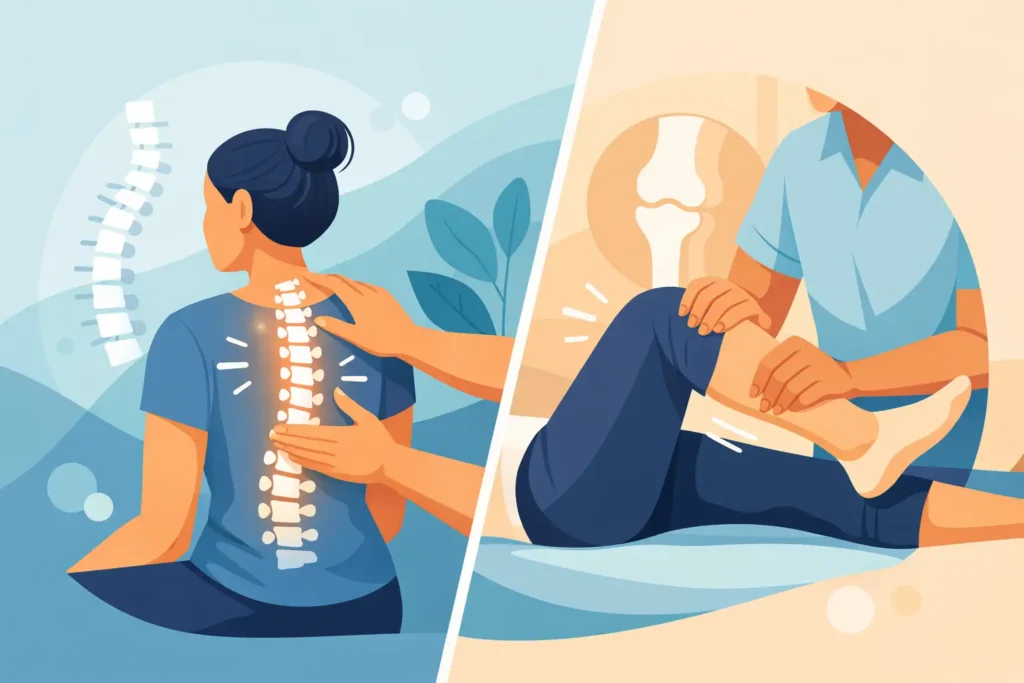
A stiff neck gets attention fast. A sore shoulder, aching hip, or ankle that never feels quite right often gets brushed off as something you just have to live with. But the body does not work in isolated parts. Spinal and extremity adjustments are often most helpful when symptoms are connected – when posture, joint mechanics, movement patterns, and nervous system stress are all influencing how you feel.
For many patients, that connection explains why pain keeps returning. You may feel discomfort in your wrist, knee, or shoulder, but the problem may also involve how your spine is moving, how your muscles are compensating, or how your body has adapted after an injury, pregnancy, long hours at a desk, or an auto accident. A thoughtful treatment plan looks at the full picture rather than chasing symptoms from one area to the next.
What are spinal and extremity adjustments?
A chiropractic adjustment is a hands-on technique used to improve joint motion and reduce restrictions that can contribute to pain, stiffness, and poor movement. When people hear the word chiropractic, they usually think of the neck and back. That is part of the story, but not the whole story.
Spinal adjustments focus on joints in the neck, mid-back, and low back. Extremity adjustments focus on joints outside the spine, such as the shoulders, elbows, wrists, hands, hips, knees, ankles, and feet. When a joint is not moving well, nearby tissues often have to compensate. Over time, that can change posture, strain muscles, irritate nerves, and make everyday activities more uncomfortable.
The goal is not simply to create a popping sound. The goal is to restore healthier motion, reduce mechanical stress, and help the body move more efficiently. Depending on the person and the joint involved, an adjustment may be gentle and low-force or more traditional and direct. Good care is never one-size-fits-all.
Why spinal and extremity adjustments are often paired
The spine and the limbs are constantly working together. If your pelvis is rotating poorly, your hip and knee may take on extra strain. If your upper back is stiff, your shoulder may not move as smoothly overhead. If your neck and posture are off, even your jaw or arm symptoms can be affected.
That is why spinal and extremity adjustments are often more effective as part of a coordinated plan instead of a spot treatment. Treating only the painful area can help, but it may not be enough if another joint is driving the problem. A person with recurring ankle pain, for example, may also have poor hip stability and spinal compensation. Someone with headaches may have neck restriction along with shoulder and upper back dysfunction from desk posture.
This is also where re-evaluation matters. Early improvements can shift what the body needs next. As movement changes, the treatment plan should change too.
Conditions that may benefit
Patients seek care for many different reasons, and not every issue calls for the exact same approach. Still, spinal and extremity adjustments are commonly used when pain or stiffness is linked to joint restriction, altered movement, or postural imbalance.
That may include neck pain, back pain, headaches, sciatic irritation, shoulder pain, elbow tension, wrist discomfort, hip tightness, knee pain, ankle restriction, and foot issues related to mechanics. They can also be useful during pregnancy when changing posture and ligament stress affect the spine, pelvis, and lower extremities.
After an auto accident, the body may develop guarding patterns that involve more than the area that took the impact. Even a relatively minor collision can leave someone with neck pain, mid-back stiffness, shoulder tightness, headaches, or low back discomfort that lingers because normal movement has not fully returned.
This does not mean every joint problem should be adjusted or that every patient is the right candidate. A proper exam helps determine whether chiropractic care is appropriate, what should be addressed first, and when a referral or additional imaging may be needed.
What to expect during care
A patient-centered visit should begin with listening. Your symptoms matter, but so do your daily routines, work demands, exercise habits, past injuries, and health goals. Pain that shows up during a workout calls for a different conversation than pain that starts after sitting at a desk all day or carrying a toddler on one hip.
From there, the clinical process should include objective assessment. That may involve posture analysis, range of motion testing, orthopedic and neurologic exams, palpation, and movement screening. If an extremity is involved, the provider should not ignore the spine. If the spine is involved, the surrounding joints and muscle function should not be ignored either.
Once the findings are clear, care can be tailored to the individual. Some patients benefit from a series of adjustments close together to calm irritation and restore motion. Others need a slower pace, lower-force methods, or a stronger emphasis on rehab exercises and home care. In many cases, the best results come from combining hands-on treatment with targeted strengthening, mobility work, and practical changes in daily habits.
Adjustments are not the whole plan
This is where many people get stuck. They think the adjustment itself is the treatment plan. In reality, it is often one part of a broader strategy.
If posture contributed to the problem, that has to be addressed. If weak stabilizing muscles are allowing the issue to keep coming back, those muscles need attention. If inflammation, stress, poor sleep, repetitive strain, or lack of movement are slowing recovery, those factors matter too.
That is why a more complete approach may include spine and postural rehabilitation exercises, home exercise instruction, soft tissue work, acupuncture, decompression, or wellness guidance around nutrition and recovery. The point is not to add services for the sake of adding services. The point is to support healing from more than one angle when the case calls for it.
At Align Chiropractic and Wellness, that whole-person mindset is central to care. Patients are not treated like a generic low back pain case or a standard shoulder complaint. They are evaluated as individuals with specific stressors, goals, and movement patterns.
Are adjustments safe?
This is a fair question, and patients should feel comfortable asking it. In the right clinical setting, chiropractic adjustments are generally considered safe when performed after an appropriate history and examination. Technique matters. So does patient selection.
A good provider does not force treatment where it is not indicated. They explain what they found, why they are recommending a certain approach, and what alternatives may be available. They also adjust the method based on age, comfort level, injury history, pregnancy status, and the condition being treated.
You may feel relief quickly, or progress may come more gradually. That depends on factors like how long the issue has been present, how inflamed the tissues are, whether compensation patterns have developed, and how consistently home recommendations are followed. Fast relief is possible, but lasting change usually comes from a plan that addresses both the irritated area and the reasons it became overloaded in the first place.
When it may be time to get evaluated
If pain keeps returning, if your range of motion is shrinking, or if you have started changing how you move to avoid discomfort, it is worth getting assessed. The same is true if headaches are becoming more frequent, desk work is wearing on your neck and shoulders, pregnancy is putting extra stress on your back and pelvis, or an old injury never seems fully resolved.
You do not need to wait until symptoms are severe. In many cases, earlier care is simpler care. Small restrictions can become larger compensation patterns over time, especially when work, parenting, commuting, training, and everyday stress all keep adding load to the system.
The right treatment should help you feel more confident in your body, not more dependent on passive care. That means understanding what is happening, having a clear plan, and knowing what you can do between visits to support progress.
Relief matters, but so does function. When your spine and extremities move the way they are supposed to, daily life tends to feel less effortful – and that can change a lot more than just pain.