
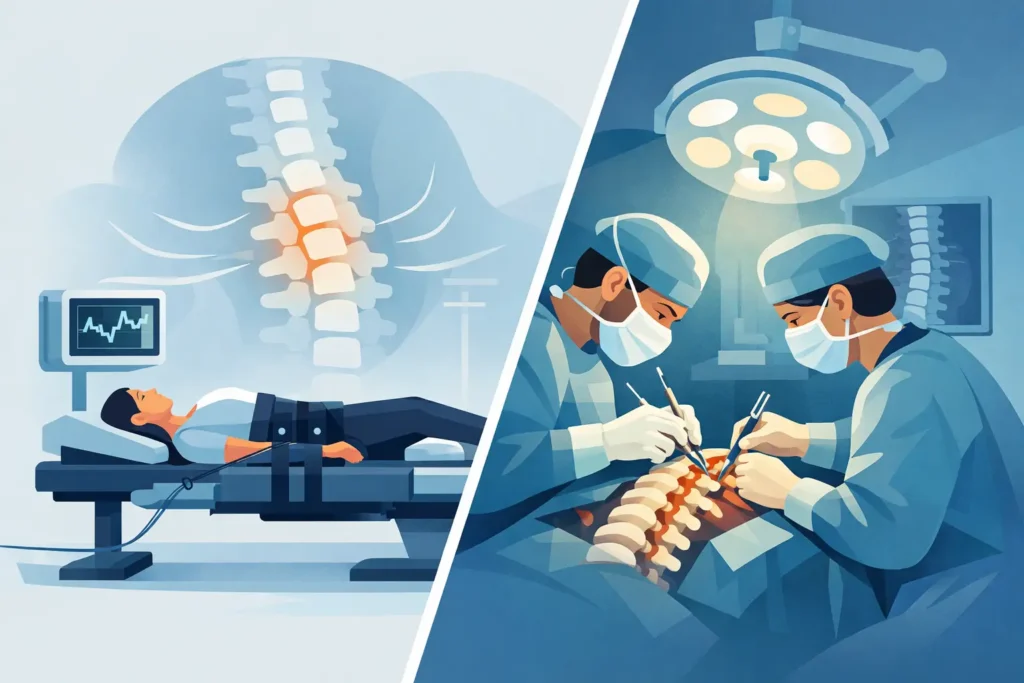
When back or nerve pain starts affecting how you work, sleep, drive, or even sit comfortably, the question of spinal decompression vs surgery becomes very real. Many people are not looking for the most aggressive option. They are looking for the right option – one that matches the cause of their pain, the severity of their symptoms, and their long-term health goals.
That distinction matters. Not every disc issue needs surgery, and not every case is a fit for conservative care alone. The best decision usually comes after a careful exam, a clear understanding of what is causing pressure on the spine or nerves, and an honest conversation about what your body is telling us.
Spinal decompression vs surgery: what is the difference?
Spinal decompression usually refers to a non-surgical treatment designed to reduce pressure on spinal discs and nearby nerves. In a clinical setting, this often involves a specialized decompression table that gently changes the position and force applied to the spine. The goal is to create space, improve disc mechanics, and support healing in irritated structures.
Surgery, on the other hand, is an invasive medical procedure used to directly remove or address tissue compressing a nerve or destabilizing the spine. Depending on the condition, that may include removing part of a disc, trimming bone, or fusing spinal segments.
These two approaches are not interchangeable, but they do overlap in the kinds of symptoms they are often used to address. Both may be considered for disc herniation, sciatica, spinal stenosis, degenerative disc changes, or chronic nerve-related pain. The difference is in how they approach the problem, how much risk they carry, and when they are medically appropriate.
When non-surgical spinal decompression may make sense
For many patients, conservative care is the right place to begin, especially when symptoms are moderate, imaging and exam findings support a mechanical disc issue, and there are no emergency neurological signs. Non-surgical decompression is often considered when pain radiates into the leg or arm, when sitting or bending worsens symptoms, or when there is disc-related pressure that may respond to offloading and rehabilitation.
This option can be appealing because it is designed to work with the body rather than force a structural change through an operation. In many cases, decompression is not used alone. It may be combined with chiropractic care, mobility work, postural retraining, home exercises, and lifestyle guidance to improve how the spine functions day to day.
That whole-person approach matters because pain is rarely just about one disc on one image. Work posture, core weakness, old injuries, repetitive stress, poor movement patterns, and even prolonged sitting can all keep a problem going. If those drivers are not addressed, symptoms can return even after temporary relief.
When surgery may be the better choice
There are situations where surgery is not only reasonable but necessary. If a patient has severe or progressive weakness, loss of bowel or bladder control, saddle numbness, major neurological decline, spinal instability, fracture, tumor, infection, or a condition that is clearly not responding to appropriate conservative care, a surgical consultation may be the safest next step.
Surgery may also be appropriate when pain is severe and persistent, quality of life is significantly reduced, and imaging plus examination findings point to a structural problem unlikely to improve enough with non-invasive treatment. For some people, especially those with advanced stenosis or a large disc injury causing ongoing nerve compromise, surgery can provide needed relief.
The key is not to think of surgery as a failure or spinal decompression as a miracle fix. They serve different purposes. Good care means knowing which path fits the patient in front of you.
Benefits and limitations of spinal decompression
One reason patients ask about spinal decompression first is that it is non-invasive. There is no incision, no anesthesia, and no surgical recovery period. Many people appreciate being able to continue with work and family responsibilities while receiving care.
Another advantage is that decompression can be part of a broader plan aimed at long-term function. If your care includes re-evaluations, corrective exercises, postural support, and guidance for home care, treatment is not just about reducing pain for a few days. It is about helping your spine handle daily life better.
Still, spinal decompression has limitations. It is not the right fit for every diagnosis. Some patients expect one therapy to solve years of degeneration, deconditioning, and movement dysfunction. That is rarely realistic. Results depend on the actual cause of symptoms, the severity of tissue involvement, how consistent the patient is with the care plan, and whether the body is in a position to heal without surgery.
Benefits and limitations of surgery
The biggest strength of surgery is that it can directly address certain structural problems when conservative care is unlikely to do enough. In the right case, surgery may reduce nerve compression more quickly or more completely than non-surgical options.
But surgery also comes with real trade-offs. There are risks related to infection, scar tissue, anesthesia, failed back surgery syndrome, and prolonged recovery. Some procedures also alter how the spine moves, which can place additional stress on nearby segments over time. Even when a surgery is technically successful, the patient may still need rehabilitation, movement retraining, and lifestyle changes to recover well and prevent future problems.
That is why surgery is usually best viewed as one tool, not a shortcut. If the underlying factors that contributed to spinal stress remain unchanged, an operation does not automatically create lasting resilience.
How doctors decide between spinal decompression vs surgery
The decision should never be based on symptoms alone or on an MRI report without context. A thoughtful recommendation starts with a full history, orthopedic and neurological testing, movement assessment, and a review of how symptoms behave throughout the day. In some cases, imaging is essential. In others, exam findings may guide the first phase of care.
A few questions usually help clarify the path forward. Is there progressive neurological loss? Is the patient stable enough for conservative care? Are symptoms improving, unchanged, or worsening? Does the pattern suggest a disc problem, stenosis, instability, or something else entirely? Has the patient already tried appropriate non-surgical treatment with good compliance?
This is where individualized care makes such a difference. Two people can both have low back pain and sciatica, yet need very different recommendations based on age, activity level, exam findings, medical history, job demands, and goals.
What recovery often looks like
Recovery with non-surgical spinal decompression is usually gradual. Most patients need a series of treatments, not one visit. Progress may include less leg pain, improved sitting tolerance, better mobility, and reduced flare-ups before full resolution happens. That timeline can be frustrating for people who want instant change, but steady improvement is often the safer and more sustainable route.
Recovery from surgery is often more intense upfront. There may be post-operative pain, activity restrictions, and a rehabilitation process that lasts weeks to months. Some patients feel major relief relatively quickly. Others improve in stages and need continued therapy to rebuild strength and confidence with movement.
Neither path is effortless. The common thread is that better outcomes usually happen when treatment is paired with active participation.
A patient-centered way to think about the choice
If your symptoms are significant but you are still a reasonable candidate for conservative care, it often makes sense to explore non-invasive options first. That does not mean delaying necessary treatment. It means making room for an approach that may reduce pain, improve function, and support healing without the risks of surgery.
At the same time, patient-centered care also means recognizing when surgery deserves serious consideration. If there are red flags, significant weakness, or clear signs that non-surgical treatment is not enough, the most supportive recommendation may be a referral for a surgical opinion.
At Align Chiropractic and Wellness, that kind of decision starts with listening. It also starts with objective assessment, clear explanations, and a care plan built around the person, not just the diagnosis. For many patients in San Antonio, the goal is not simply to chase pain relief. It is to move better, heal more fully, and return to life with more confidence.
If you are weighing your options, the most helpful next step is not guessing. It is getting examined by a provider who can identify what is driving your symptoms and explain whether conservative care is a smart place to start. The right plan should make sense for your body, your life, and where you want your health to go next.