
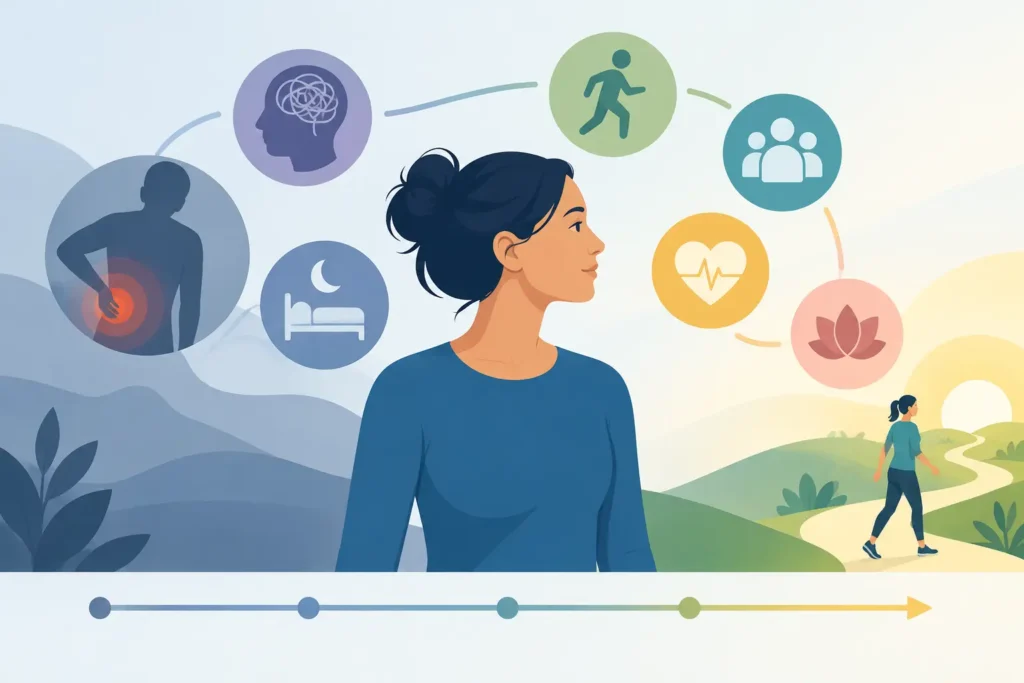
Pain that lasts for months can begin to shape nearly every decision you make. You may avoid a favorite workout, hesitate before picking up your child, lose sleep while trying to find a comfortable position, or push through work only to feel worse at the end of the day. Chronic pain outcomes are not defined by a single treatment or a pain score alone. They reflect how well you can move, sleep, work, participate in family life, and feel confident in your body again.
For many people, lasting improvement starts when care looks beyond the painful area. A sore lower back may be connected to prolonged sitting, weak movement patterns, an old injury, poor recovery, or stress that keeps the body tense. Neck pain and headaches may be influenced by posture, workstation habits, sleep position, jaw tension, or reduced mobility through the upper back. A whole-person assessment helps identify the factors that may be keeping pain active.
What Do Better Chronic Pain Outcomes Look Like?
Pain relief matters, but it is only one measure of progress. A meaningful outcome may be waking up with less stiffness, sitting through a meeting without frequent repositioning, returning to walks around the neighborhood, or getting through a shift with more energy left for your family. For an active adult, it may mean lifting, running, or playing a sport with greater confidence and fewer flare-ups.
Because chronic pain can affect people differently, the right goals are personal. Someone recovering from an auto accident may need to restore comfortable neck movement and rebuild tolerance for driving. A pregnant patient may want relief from pelvic or low back discomfort while staying active and supported through changing physical demands. Another person may be focused on reducing recurring sciatic symptoms that interfere with work and sleep.
Better outcomes also include greater self-awareness. When you understand what aggravates symptoms, what helps your body recover, and how to respond early to a flare-up, pain can feel less unpredictable and less controlling.
Why Chronic Pain Can Persist
Chronic pain is not always a sign that something is seriously damaged, but it should never be dismissed as “all in your head.” Pain is real, and it can become more complex when it continues. Muscles may guard against movement, joints may lose mobility, and the nervous system can become more sensitive after repeated irritation, injury, or prolonged stress.
Daily habits can add to the problem. Hours of sitting with the head forward, repetitive lifting, limited movement during the workday, poor sleep, and insufficient recovery can all place ongoing demand on the body. Even when an original injury has begun to heal, the movement patterns developed around that injury may continue to create strain.
This is why a quick fix is not always enough. Rest may be useful during an acute flare-up, but too much avoidance can lead to deconditioning and fear of normal movement. On the other hand, pushing through sharp or worsening pain can also be counterproductive. The goal is to find a safe, appropriate path back to activity that matches your condition and current capacity.
The Value of an Individualized Assessment
A thoughtful care plan begins by listening to the full story. When did your symptoms begin? Was there an injury, accident, pregnancy-related change, work demand, or gradual buildup? What movements make symptoms better or worse? How are pain, sleep, stress, and daily responsibilities affecting one another?
Objective assessment can provide useful direction. Depending on your needs, this may include evaluating posture, spinal and extremity mobility, muscle function, movement patterns, and areas of tenderness or irritation. These findings help connect symptoms with the underlying mechanical and lifestyle factors that may be contributing to them.
At Align Chiropractic and Wellness, care is built around this individualized approach rather than a one-size-fits-all schedule. Regular re-evaluations matter because your body and goals can change as you improve. A plan should be adjusted when progress calls for more mobility work, greater strengthening, different home exercises, or a focus on another contributing area.
Care May Include More Than One Tool
For some patients, chiropractic adjustments can help restore motion in restricted spinal or extremity joints and reduce mechanical stress. Others may benefit from spinal decompression when specific disc-related or nerve-related symptoms are part of the clinical picture. Acupuncture may be appropriate for supporting pain relief and muscle relaxation in certain cases.
Rehabilitation is equally important. Guided spine and postural exercises can improve strength, control, and endurance so that relief is supported by better movement over time. Home exercise instruction gives patients a practical role between visits, while nutrition and supplementation guidance may support broader wellness goals when appropriate.
No single therapy is right for every person. The best combination depends on your diagnosis, health history, symptom pattern, tolerance for activity, and goals. A personalized plan gives each part of care a purpose.
Habits That Can Support Better Results
Treatment visits are valuable, but the hours between appointments influence chronic pain outcomes too. Small, consistent changes often have more impact than occasional major efforts. If sitting increases your low back or neck pain, brief movement breaks during the day may be more helpful than waiting until discomfort becomes intense. If sleep leaves you stiff, changes to your sleep position, pillow support, or evening routine may be worth discussing.
Movement should be progressed thoughtfully. Gentle walking, mobility work, and condition-specific exercises can help build tolerance without overwhelming the body. The right dose depends on the person. Mild soreness after activity can sometimes be expected, while sharp pain, increasing numbness, weakness, or symptoms that persist well beyond activity deserve attention and adjustment.
Stress management is also part of physical recovery. Stress does not cause every painful condition, but it can increase muscle tension, disrupt sleep, and make symptoms feel more intense. Breathing exercises, regular activity, adequate hydration, nourishing meals, and protected time for recovery can support the body’s ability to adapt.
Progress Is Rarely a Straight Line
One of the most helpful expectations to set is that recovery may not be perfectly linear. You may have a strong week followed by a flare-up after a long drive, a demanding work project, poor sleep, travel, or an unfamiliar activity. A flare-up does not automatically mean you are back at the beginning.
Instead, it can be useful information. It may show that your body needs a modified activity level, better pacing, more consistent home care, or an adjustment to your treatment plan. Tracking changes in pain, mobility, sleep, and function can make progress more visible, especially when day-to-day improvements feel subtle.
Patience is not passive. It means continuing with a plan, communicating clearly about changes, and building capacity step by step. The aim is not to make your life smaller to avoid pain. It is to help you return to the movements and responsibilities that matter to you with greater resilience.
When Pain Needs Prompt Medical Attention
Chronic pain should be evaluated carefully, particularly when symptoms change. Seek prompt medical attention for new or worsening weakness, loss of bowel or bladder control, numbness in the groin area, severe pain after significant trauma, unexplained fever, or unexplained weight loss. These symptoms may require urgent evaluation beyond conservative musculoskeletal care.
For persistent back pain, neck pain, headaches, sciatica, or post-injury discomfort without those warning signs, an assessment can help clarify the next step. You do not have to wait until pain has taken over every part of your routine to ask for support.
Meaningful change often begins with one practical goal: sleep more comfortably, take a walk without fear, sit through dinner, or get back to caring for your family with less limitation. With attentive assessment, personalized care, and steady participation in your own recovery, those goals can become a realistic place to start.