
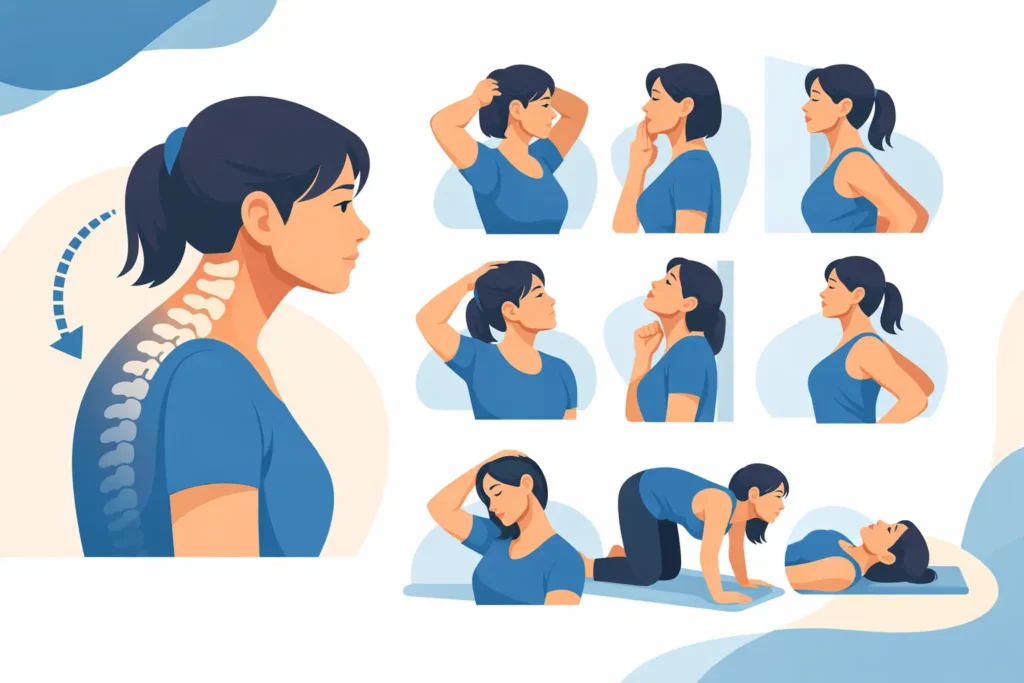
By the time most people notice their posture, their body has already been compensating for it for months or even years. The neck feels tight by midafternoon, the shoulders creep forward, and headaches show up after long hours at a desk or on a phone. Forward head posture exercises can help, but the right approach matters. If you only stretch what feels tight and ignore what has become weak, the problem often keeps coming back.
Forward head posture happens when the head sits too far in front of the shoulders instead of being balanced over them. That small shift changes more than appearance. It increases strain on the muscles, joints, and supporting tissues of the neck and upper back. Over time, people may notice neck pain, upper back tension, jaw discomfort, shoulder irritation, numbness into the arms, or frequent tension headaches.
The good news is that posture can improve. In many cases, it responds well to a combination of mobility work, muscle retraining, ergonomic changes, and hands-on care when needed. The goal is not to force your body into a stiff, military-style posture. The goal is to restore a more natural alignment that feels sustainable in real life.
Why forward head posture develops
Forward head posture rarely comes from one single cause. More often, it builds gradually through daily habits and stress patterns. Long hours at a computer, driving, scrolling on a phone, carrying stress in the shoulders, and sleeping in awkward positions can all contribute.
It also tends to involve a predictable pattern in the body. The muscles at the front of the chest and neck may become shortened or overactive, while the deep neck stabilizers and upper back muscles become weaker or less coordinated. That is why correcting posture usually requires more than one exercise. You need to improve mobility in one area while restoring support and control in another.
This is also why some people do online posture exercises for weeks without much change. If joint restriction, spinal irritation, old injury patterns, or poor workstation setup are part of the picture, exercises alone may not fully solve it.
Forward head posture exercises that address the real problem
These exercises are most helpful when done gently and consistently. None of them should create sharp pain, tingling, dizziness, or worsening headaches. If that happens, stop and get evaluated.
1. Chin tucks
This is often the starting point because it retrains the deep muscles that help support the neck in a better position. Sit or stand tall and look straight ahead. Without tipping your head up or down, gently draw your chin straight back as if you are making a small double chin. Hold for a few seconds, then relax.
The movement should feel subtle. If you force it, you may end up recruiting the wrong muscles. Done correctly, chin tucks help bring the head back over the shoulders rather than letting it drift forward.
2. Wall posture holds
Stand with your back against a wall, with your upper back lightly touching it. Gently draw your chin back and let the back of your head move closer to the wall without straining. Keep your ribs relaxed and avoid arching your low back to compensate.
This exercise gives your body a reference point for alignment. It can be surprisingly challenging, which is often a sign that your posture has become your normal. A short hold repeated consistently can help your system learn a more balanced position.
3. Doorway chest stretch
A tight chest often pulls the shoulders forward and makes it harder to maintain good neck alignment. Stand in a doorway with your forearms on the frame and gently lean forward until you feel a stretch across the front of the chest.
You should feel opening through the chest, not pinching in the shoulder joint. If both arms at once feels too aggressive, stretch one side at a time. This can be especially useful for people who spend most of the day typing or driving.
4. Upper trapezius stretch
Sit tall and gently tilt one ear toward the same-side shoulder until you feel a mild stretch on the opposite side of the neck. You can place your hand lightly on your head for a little assistance, but do not pull hard.
This stretch can reduce the tension that builds when the shoulders stay elevated and the neck works overtime. It should feel relieving, not intense. If you feel nerve symptoms down the arm, it is better to stop and have the area assessed.
5. Levator scapulae stretch
This muscle often becomes tight in people with neck stiffness and desk-related posture issues. Turn your head about 45 degrees, then look downward as if you are aiming your nose toward your armpit. You should feel a stretch along the back or side of the neck.
Because this muscle helps connect the neck and shoulder blade, releasing it can improve both neck comfort and shoulder mechanics. It is one of those areas that many people do not realize is contributing to their pain.
6. Scapular retractions
Sit or stand with your arms relaxed. Gently draw your shoulder blades back and slightly down, then release. Think of broadening across your collarbones rather than squeezing hard.
This helps wake up the muscles that support the upper back. Stronger and more coordinated shoulder blade control often makes it easier for the neck to stop overworking. If you spend a lot of time hunched forward, this is an important piece of the puzzle.
7. Thoracic extension over a chair or foam roller
When the upper back becomes stiff and rounded, the neck often extends forward to compensate. Improving thoracic mobility can take pressure off the cervical spine. Sit in a chair with a supportive back at shoulder blade height, place your hands behind your head, and gently extend backward over the chair.
You can also use a foam roller under the upper back. The movement should come from the mid-back, not by cranking the neck. This exercise is helpful, but it is not a fit for everyone, especially those with certain spinal conditions, so technique matters.
8. Wall angels
Stand with your back against a wall and your arms bent like goalposts. Keep your chin gently tucked and slide your arms upward and back down while maintaining contact as much as you comfortably can.
This combines mobility and control through the upper back, shoulders, and neck. It can expose just how much stiffness or compensation is present, which is useful. Start small if full range feels awkward.
How often should you do forward head posture exercises?
Most people do better with short, frequent sessions than with one long workout once a week. Five to ten minutes a day is often more effective than doing everything perfectly on Sunday and forgetting about it the rest of the week.
That said, more is not always better. If you are already inflamed, pushing hard can make the neck more irritated. A thoughtful plan usually works best: a few mobility drills, a few activation exercises, and changes to the daily habits that created the problem in the first place.
What else needs to change for posture to improve?
Exercises help, but they work better when your environment supports them. If your monitor is too low, your laptop keeps you folded forward, or your phone use is constant, your body keeps rehearsing the same stress pattern all day. Even the best exercise routine has a harder job under those conditions.
Small changes matter. Raise screens to eye level when possible. Bring your phone closer to your face instead of dropping your head to it. Use back support when sitting for long periods. Take movement breaks before tightness builds. If you drive often, check whether your seat position keeps your head poking forward.
Sleep setup can matter too. A pillow that is too high or too flat may leave the neck in a poor position for hours. There is no one perfect pillow for everyone, but the goal is to keep the neck in a more neutral alignment rather than bent sharply forward or sideways.
When exercises are not enough
If your posture issue comes with recurring headaches, persistent neck pain, numbness, radiating symptoms, jaw tension, or pain after an auto accident, it is worth getting a more complete evaluation. Posture problems can overlap with joint dysfunction, disc irritation, whiplash, shoulder restriction, or muscular imbalances that need individualized care.
That is where objective assessment becomes valuable. A good exam looks at more than where your head sits. It should also assess spinal movement, muscle balance, nerve irritation, work habits, past injuries, and how your body responds over time. In a clinic setting, treatment may include chiropractic adjustments, soft tissue work, postural rehabilitation, home exercise instruction, and periodic re-evaluations to track progress.
At Align Chiropractic and Wellness, that whole-person approach matters because the goal is not simply to tell someone to sit up straighter. The goal is to understand why their posture changed, what symptoms it is driving, and what combination of care will actually help it improve.
Posture does not change overnight, and it should not feel like a constant battle with your own body. With the right forward head posture exercises, better movement habits, and the right support when needed, many people begin to notice less tension, fewer headaches, and a neck that feels more stable and comfortable through the day. If that sounds like the kind of progress you have been looking for, the next best step is to get your posture evaluated and start with a plan built for your body.